

.svg.svg)


Contact us

Last Updated: September 15, 2026
If you want to understand why explore Manchester through local food, start with this: a city's plate is its autobiography, written in spice, smoke and gravy. This guide from Flavours of Manchester explains what those dishes reveal, and how to read them properly.
Manchester's story is one of arrivals. Cotton wealth built the mills, the mills pulled in workers, and workers brought recipes. That is why the city eats the way it does. Every dish on a local menu carries a layer of that history.
Here is the thing most visitors miss. The famous dishes are not the interesting part. The interesting part is where they sit, and who is still cooking them the way their grandmothers did.
Manchester's food map was drawn by industry. Irish migrants arrived during the potato famines of the 1840s, Jewish communities settled in Cheetham Hill, and South Asian families put down roots in Rusholme from the 1950s onwards (manchester.gov.uk). Each wave opened kitchens. Those kitchens became landmarks.
The most visible result is the Curry Mile, the stretch of Wilmslow Road in Rusholme lined with South Asian restaurants, sweet shops and grills. It grew alongside the city's textile trade and never left.
Then came the modern chapter. Independent coffee roasters, natural wine bars and small-plate kitchens moved into the Northern Quarter and Ancoats, often into former warehouses and workshops. The old industrial footprint is still visible in the buildings.
That layering is the point. A single afternoon of eating can move you through 180 years of migration and reinvention. Few cities make that timeline so easy to taste.
The best food in Manchester is often behind an unmarked door. Family-run kitchens, basement bakeries and back-street cafés rarely advertise, and many sit outside the usual tourist routes.
This is where local knowledge changes the experience. A guide who eats in these places regularly knows which stall to visit on which day, which dish to order first, and which venue has a queue worth joining.
Some of the city's longest-running kitchens have served the same recipes for decades, often with the same family at the pass. These places tend to be small, busy and quietly excellent.
A common mistake is treating them as a quick stop. Sit down, order slowly, and talk to the people running the place. That conversation is often the best part of the meal.
The difference between Manchester food walks and guided tours comes down to structure. A food walk is a loose, on-foot exploration with a host who adapts to the group and the day. A guided tour usually follows a fixed route and timetable.
Both have a place. Here is how they compare in practice.
Feature | Food Walk | Guided Tour |
|---|---|---|
Route | Flexible, host-led | Fixed and scheduled |
Group size | Usually smaller | Often larger |
Pacing | Adapts to the group | Set by the itinerary |
Best for | Curious eaters, locals | First-time visitors |
Booking | Often direct with the host | Usually through a platform |
For anyone wondering whether a food walk is worth it over simply booking tables yourself, the answer is usually yes, and not because of the food alone. You are paying for access, context and timing. A host gets you into small kitchens that do not take large bookings, orders the dishes worth ordering, and explains what you are eating.
Typical food tours run between two and four hours, covering roughly four to six stops (Domestic tourism: latest annual results). Shorter formats suit families and lunch breaks. Longer ones suit groups who want a full afternoon with drinks included.
Group size matters more than duration. Smaller groups move faster, get more time with each host, and feel less rushed. If you are booking for a larger party, ask about splitting into smaller sub-groups.
Dietary requirements are usually workable with notice. Vegetarian, vegan, halal and allergy-friendly routes are common, but they need to be arranged in advance rather than sprung on the day.
A good route moves with the city rather than against it. Start in the Northern Quarter for coffee and small plates, cross into Ancoats for the newer independent kitchens, then head towards the city centre for something traditional.
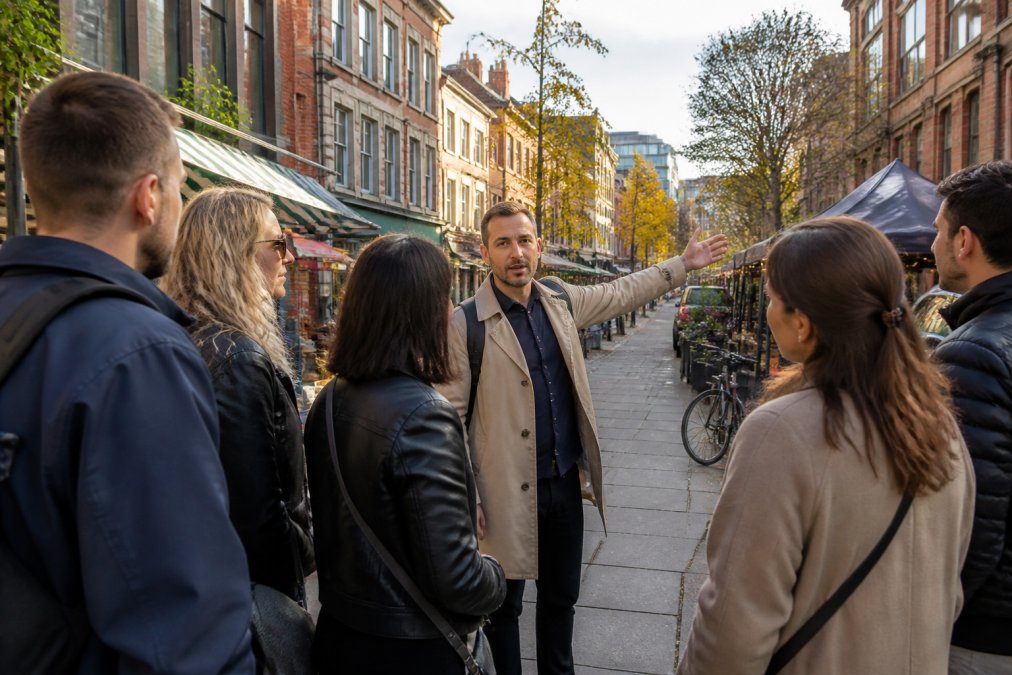
From there, Salford rewards the extra walk. Its food scene has grown quickly, and the riverside areas now sit alongside long-established local pubs and cafés. The contrast between the two cities within a few minutes of each other is part of the appeal.
Plan around three to four hours, with two or three proper stops rather than six rushed ones. Build in walking time. The distance between neighbourhoods is short, but the streets are busy.
Food tours work for three quite different audiences, and the best operators design for each.
For visitors, the appeal is orientation. A few hours of eating doubles as a map of the city and its history. For residents, the appeal is the opposite: discovering places you have walked past for years without noticing. For corporate groups, the appeal is a shared experience that gets people talking without the awkwardness of a formal team-building exercise.
This is where Flavours of Manchester fits. Its guided food and drink walking tours cover Manchester and Salford, blending local history and culture with the city's best eateries and bars. Tours such as Taste of Two Cities and Cottonopolis are built around that storytelling approach, and corporate and private options are available for groups who want something tailored.
If you are planning a team day or a client outing, the practical question is capacity and engagement. Ask how the operator keeps a larger group involved, and whether the route can flex around dietary needs or mobility. Good operators answer both without hesitation.
For more on routes, group sizes and booking, see the official Visit Manchester guide to the city's food and drink scene, which maps many of the independent venues mentioned here.
Manchester's food scene rewards curiosity, but it does not hand its best kitchens to people who only follow the obvious route. The difference between a good afternoon and a memorable one is usually the host, the access and the stories behind each stop.
Flavours of Manchester runs guided food and drink walking tours across Manchester and Salford, with specialised routes including Taste of Two Cities, Cottonopolis, and Inspiration, Innovation & Intellect, plus corporate and private tour options for groups. If you want to discover the city's best eateries and bars while hearing the history behind them, get started with Flavours of Manchester and see the city one bite at a time.
A guided food walking tour combines tasting stops at independent eateries with storytelling about the city's history and culture. You walk between venues in a small group, sampling dishes at each stop while your guide explains the area's past. Tours typically last two to three hours and cover a mix of savoury bites, sweet treats and sometimes drinks. Dietary requirements can usually be accommodated if you mention them when booking.
Most food tours run between two and three hours, covering four to six tasting stops with walking in between. Some operators offer shorter one-hour tasters or longer half-day experiences. For corporate groups, tours can often be scheduled in the late afternoon or early evening to fit around working hours. Check the specific tour page for exact durations before booking.
Many long-term residents are surprised by the hidden gems a good food tour uncovers. Guides often take groups to family-run kitchens, back-street bakeries and neighbourhood restaurants that don't appear in mainstream listings. The history and context shared along the way also reframes places you walk past every day. If you want a genuinely fresh perspective on your own city, a themed tour is a strong starting point.
Start by deciding what matters most: cuisine type, area covered, group size or duration. Check whether the operator can handle your group size and any dietary restrictions. Read reviews from people who have actually taken the tour to gauge how personal and engaging it feels. For corporate bookings, ask about private options and whether the route can be tailored to your team's interests.


