

.svg.svg)


Contact us

Last Updated: August 3, 2026
Understanding private food tour group size limits is essential for planning an immersive culinary experience in Manchester. Group size fundamentally shapes what you'll experience, affecting experience quality, meaningful interaction between guests and venues, and your guide's ability to deliver the stories and insights that make Manchester's food culture worth exploring.
Private food tour group size limits typically fall into four distinct categories, each with its own characteristics, operational requirements, and guest experience profile.
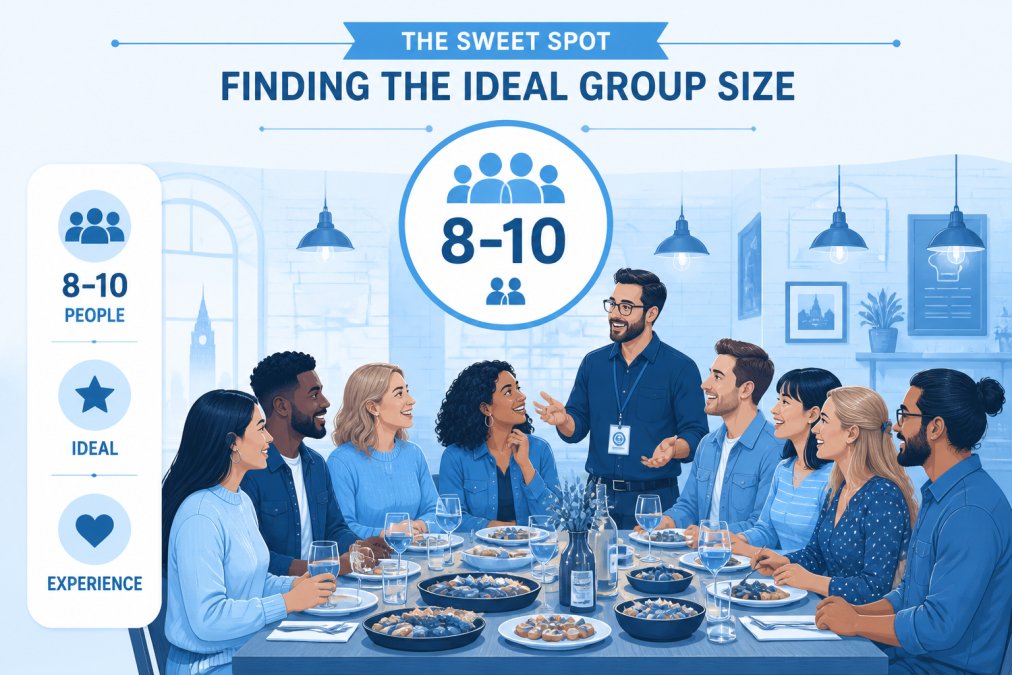
An intimate group of 2-6 people represents the most personalised private food tour experience. Your guide can maintain genuine conversation with every guest, adapt the itinerary based on interests, and ensure dietary requirements or accessibility needs are handled seamlessly. Venues accommodate special requests, prepare off-menu items, or adjust portions. The trade-off is straightforward: intimate groups pay higher per-head costs because operational overhead spreads across fewer people.
Small group tours represent a sweet spot for many travellers and corporate teams. At 7-12 people, you maintain intimacy for meaningful interaction while achieving better per-head pricing than intimate groups. Your guide can still facilitate conversation across the entire group, and venues remain accommodating. Walking through Manchester with a small group feels like locals exploring rather than a tour group.
Medium groups of 13-20 people represent a significant operational shift. Your guide transitions from facilitating individual conversation to managing group dynamics. Venues require advance planning; many restaurants can't accommodate 15+ people without splitting seatings or reserving the entire space. Walking requires attention to pacing and sight lines, and your guide may need microphones. Per-head costs typically drop compared to smaller groups.
Large corporate groups of 20+ people require fundamentally different operational approaches. Many tour operators split groups into multiple smaller tours or partner with larger venues. Walking tours become logistically challenging, and restaurants typically can't accommodate such groups in normal dining flow. Large groups offer significant per-head cost reduction but with reduced flexibility and less guide-guest interaction.
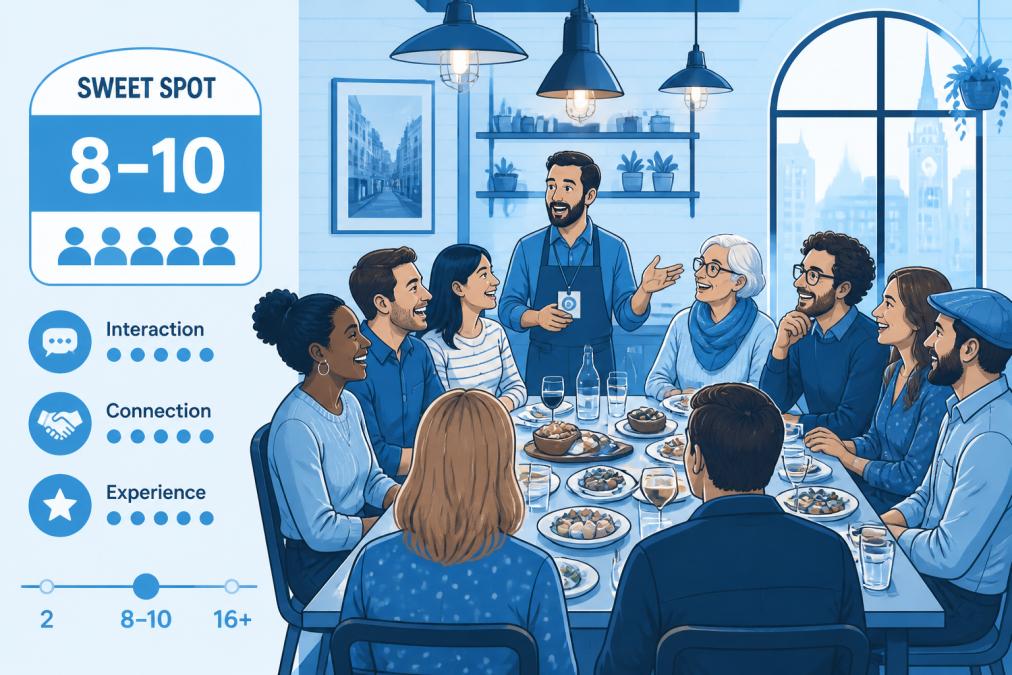
Research consistently shows that 8-12 people represents the optimal range for balancing experience quality, operational efficiency, and cost. At this size, your guide can facilitate genuine conversation without amplification. Restaurants accommodate your group without special event planning. Walking feels like a cohesive group exploring together, and per-head costs are reasonable.
This size works because it aligns with how hospitality venues operate. Most restaurants can seat 8-12 people at a single table or adjacent tables within normal service flow. Kitchens prepare food without shifting into event-catering mode. Your guide maintains eye contact with everyone and can adapt if dietary requirements weren't communicated clearly.
The sweet spot also depends on group composition. A group of 10 close friends has different dynamics than 10 colleagues who barely know each other. Familiar groups handle slightly larger sizes because social cohesion already exists.
The relationship between group size and guest experience is direct. Smaller groups consistently report higher satisfaction because they experience less friction, more personalisation, and stronger connection to the guide and venues.
The tour guide ratio, guests per guide, is the primary driver of service quality. A single guide managing 6 people can maintain conversation with each individual and adapt in real time. The same guide managing 20 people must prioritise group management over individual attention.
Most professional food tour operators maintain a guide-to-guest ratio of 1:10 or better for quality experiences. Some operators use co-guides for larger groups: one lead guide handling narrative, a second managing logistics.
Venue access creates hard operational constraints. A restaurant welcoming a 6-person group might require weeks' notice for 15 people. A 20-person group might exceed capacity entirely, forcing the operator to partner with larger spaces or split the group.
Smaller groups visit neighbourhood restaurants, independent cafés, and intimate wine bars where owners greet you personally. Larger groups get routed to higher-capacity venues, often larger chains or dedicated event spaces rather than hidden local gems.
Group dynamics shift noticeably at different sizes. Groups of 4-6 have one conversation thread. At 8-10, you might have two clusters, but the guide reaches everyone. At 15+, natural subgroups emerge, and your guide's role shifts from facilitating group conversation to managing multiple dynamics.
For corporate groups, research suggests 8-12 people is optimal for building connection during shared experiences. Smaller groups can feel exclusive; larger groups fragment, and team-building benefits diminish.
Private food tour group size limits reflect real operational constraints that venues, guides, and the city impose.
Manchester's independent restaurants typically have 40-80 seats total. A 15-person private group represents 20-40% of capacity. Most restaurants accommodate walk-in groups up to 6-8 people without reservation. Groups of 10-15 require 1-2 weeks' notice. Groups of 20+ require weeks of planning and often multiple venues or dedicated private dining space.
The kitchen's capacity to prepare food for your group is a hard operational limit. A professional kitchen handles a 6-person group's custom dietary requirements easily. A 20-person group with multiple dietary restrictions requires advance planning, ingredient sourcing, and modified prep procedures.
Most venues require groups larger than 12 people to provide final headcount and dietary requirements 1-2 weeks in advance. Food preparation quality can also be affected by group size; smaller groups allow individual plate preparation with attention to plating and timing.
Walking tours present real accessibility challenges that scale with group size. A guide managing 6 people can easily adjust pace for mobility limitations. A guide managing 20 people faces a dilemma: move at the slowest person's pace or leave slower participants behind.
Manchester's city centre includes cobbled streets, uneven pavements, and stairs in many venues. If your group includes people with mobility considerations, communicate this clearly when booking. Smaller groups allow more flexibility. Larger groups require advance planning to ensure genuine accessibility for everyone.
Corporate food tour booking requirements differ significantly from leisure bookings. Corporate groups typically have fixed dates, larger headcounts, specific dietary requirements, and budget constraints.
Most professional food tour operators have a minimum group size of 4-6 people for private tours. Maximum group sizes vary; some operators cap at 12, others accommodate 25+ using multiple guides. When booking, clarify the operator's minimum and maximum before committing.
Corporate groups almost always include dietary requirements beyond standard vegetarian/vegan options. Professional tour operators manage dietary requirements by working with venues in advance, providing detailed dietary breakdowns weeks before the tour.
Customisation options expand with corporate bookings. Leisure groups follow standard itineraries. Corporate groups often want customisation, perhaps focusing on sustainable practices, local suppliers, or Manchester's industrial food heritage.
Per-head pricing typically follows a tiered structure: smaller groups pay more per person, larger groups pay less. Pricing depends on quantity, dates, and delivery. Most pricing includes guide time, food tastings at multiple venues, and curated storytelling. Alcoholic beverages beyond tastings are usually extra.
Tour operators typically require non-refundable deposits (25-50% of total cost) at booking, with full payment required 2-4 weeks before the tour. Most operators allow small changes but require notice for larger adjustments. Understand the cancellation policy before booking, particularly for corporate events where scheduling can shift.
Private food tours in Manchester increasingly offer customisation options allowing groups to shape the experience around their specific interests.
The most comprehensive customisation is bespoke itinerary planning, where you work with the tour operator to design a tour specifically for your group. This might mean focusing on a particular neighbourhood, specific cuisine, or thematic approach like sustainable food or Manchester's industrial food heritage.
Bespoke itineraries require advance planning, typically 4-8 weeks for a 12-15 person group. Customisation is easier for smaller groups (under 12 people) because venues are more flexible.
Some tour operators offer semi-private tours, scheduled public tours where your group is guaranteed seats but may join other groups. This option is cheaper than fully private tours while providing some group cohesion and dedicated guide attention. Semi-private tours work well for smaller groups (4-8 people) where cost savings are meaningful.
Private food tours involve movement through the city, food consumption from various venues, and interaction with multiple environments. Walking tours in Manchester are generally safe, but participants should be aware of physical demands. Tours typically involve 2-4 hours of walking over uneven pavements with stairs in some venues. Comfortable walking shoes, weather-appropriate clothing, and reasonable fitness levels are essential.
Food safety is managed by venues themselves; all UK restaurants must comply with Food Standards Agency regulations. Tour operators select venues with strong safety records. Individuals with severe allergies should communicate this clearly and verify venues can accommodate requirements safely.
Professional tour operators carry public liability insurance covering guests. Verify your operator is insured before booking. Weather presents practical challenges; Manchester's weather is unpredictable. Tours typically proceed in light rain but may be rescheduled in severe weather. Confirm the operator's weather policy and rescheduling options before booking.
The question of private food tour group size limits comes down to matching group size to your specific goals, budget, and preferences. Intimate groups of 4-6 deliver unmatched personalisation but cost more per head. Groups of 8-12 represent the operational sweet spot, balancing quality, cost, and group dynamics. Larger corporate groups (15-25+) require more planning but deliver significant cost savings and memorable team experiences when properly coordinated.
When booking a private food tour in Manchester, clarify your priorities: Are you seeking intimate connection with a knowledgeable guide, or organising a structured team event? Do you have specific dietary requirements or accessibility needs? What's your budget?
Flavours of Manchester specialises in private group food tours adapting to your specific needs. We accommodate groups from 4 people to 25+, with flexible customisation, experienced guides who know Manchester's food scene deeply, and established relationships with independent restaurants across the city. Whether you're organising a corporate away day, celebrating with friends, or exploring Manchester's culinary landscape, we deliver an experience tailored to your group size and preferences.
Ready to explore Manchester's vibrant food culture with your group? Get started with Flavours of Manchester and discover the city's best eateries through an immersive guided experience designed specifically for your group size and preferences. Visit Flavours of Manchester for private tour booking and group size options
Group Size | Best For | Operational Complexity | Typical Per-Head Cost | Guide Ratio |
|---|---|---|---|---|
2-6 people | Intimate celebrations, couples, small families | Low | Premium | 1:6 |
7-12 people | Friend groups, small corporate teams, leisure tourists | Low-Medium | Moderate | 1:10 |
13-20 people | Corporate away days, large celebrations | Medium | Lower | 1:15 |
20+ people | Large corporate events, team-building | High | Lowest | 1:20+ |
Key Takeaways on Group Size Limits:
The ideal group size for private food tours typically falls between 8 and 12 people. This range allows your guide to maintain meaningful interaction with each guest while ensuring venues can accommodate your party comfortably. Smaller groups (2-6) offer a more intimate experience, whilst larger corporate groups (15+) require advance planning and may split into multiple guides to maintain service quality. The best choice depends on your priorities: personalised attention, budget, or specific venue preferences.
Capacity limits reflect operational constraints across multiple venues. Restaurants must have reserved seating available, kitchens need advance notice for portion planning, and guides can only effectively manage a certain number of guests simultaneously. Walking routes also have practical limits based on pavement space and safety. Larger groups (18+) often require multiple guides, split-timing across venues, or semi-private arrangements. Tour operators coordinate with each venue beforehand to confirm they can accommodate your group size and any dietary requirements.
Groups of 20 or more typically require formal booking at least 2-3 weeks in advance. You'll need to confirm final headcount, specify any dietary restrictions (allergies, vegetarian, vegan, religious requirements), and discuss whether the tour will run as a single large group with multiple guides or split into smaller semi-private tours. Most operators require a deposit, have specific cancellation policies, and offer tiered pricing based on group size. Custom itineraries can often be arranged to suit your team's interests or Manchester locations relevant to your business.
Group size limits protect the quality of your experience. Larger groups make it harder for guides to share stories and engage individually with guests, reduce the intimacy at food stops, and strain venue capacity. Practical constraints include guide-to-guest ratios (typically 1 guide per 10-12 guests), restaurant table availability, kitchen preparation time, and walking route safety. Operators impose these limits to ensure every guest receives attentive service, can hear their guide clearly, and enjoys meaningful interaction with both the guide and fellow participants.
[EXTERNAL_LINK: Food Standards Agency guidance on food safety for hospitality venues | food.gov.uk]
[EXTERNAL_LINK: Manchester City Council accessibility information for visitors and tour operators | manchester.gov.uk]
[EXTERNAL_LINK: British Institute of Professional Photography standards for event documentation | bipp.com]
This article was written using GrandRanker


