

.svg.svg)


Contact us

Last Updated: August 4, 2026
Whether a food tour is worth it depends on what you're seeking. At Flavours of Manchester, we've guided thousands through the city's culinary landscape. A food tour isn't just a meal, it's access to stories, connections, and places you wouldn't find independently. But it's also a structured group experience with time constraints. Understanding the actual value proposition before you commit is essential.
The tour price covers three distinct things, and most people only think about one.
First, there's the food itself: multiple tastings across 3-5 stops, each curated to showcase a neighbourhood's character. You're paying for a guided tasting experience, not restaurant prices for full meals.
Second, you're paying for a guide's knowledge. A good guide transforms a walk into a narrative, explaining why a neighbourhood developed its food scene and connecting what you're eating to Manchester's identity. Without that context, you're just eating.
Third, you're paying for curation and logistics. The operator has vetted every stop, negotiated group arrangements, and built relationships with local businesses. They've absorbed the risk of a venue underperforming on the day.
The advertised price is rarely the full picture.
Drinks are often extra. Gratuities matter too. Travel to the starting point, dietary modifications, and opportunity cost (time not spent elsewhere) can add to the total cost.
A standard Manchester food tour runs 2.5 to 3 hours and visits 4-6 stops, typically in the Northern Quarter, Spinningfields, or Deansgate. Each stop lasts 20-30 minutes, long enough to sample food and chat with owners, but not so long that you feel rushed.
Tours usually begin with neighbourhood history, explaining why the area became a food destination and how the current scene reflects Manchester's character. You'll then move through stops showcasing different culinary traditions: a street food vendor, a specialist food shop, a small restaurant, and possibly a craft producer. Portions are small by design, letting you experience multiple venues without feeling uncomfortably full.
Your guide controls the flow, ensuring the group stays together at a manageable pace. Group dynamics matter most here, an engaged group creates an immersive experience.
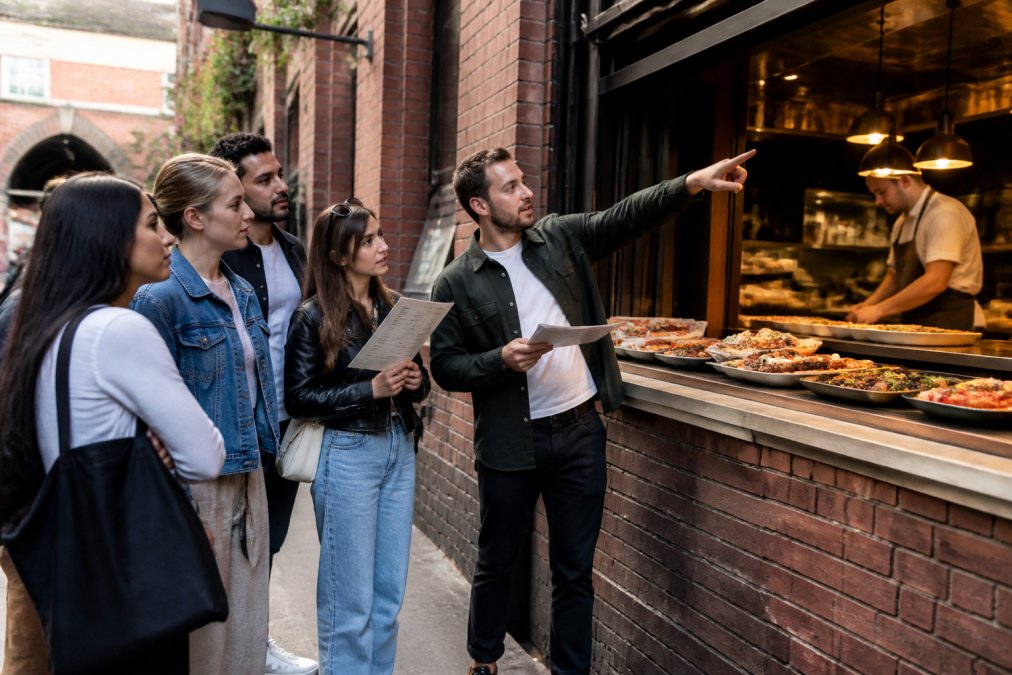
The quality of your experience hinges almost entirely on your guide. A knowledgeable guide explains why a dish matters to Manchester's culinary identity and which owner has been running their business for decades. At Flavours of Manchester, guides balance expertise with accessibility, asking questions and adjusting commentary to match the group's energy.
Poor guides treat the tour like a script, hitting talking points without genuine engagement. The difference between mediocre and great often comes down to whether your guide feels like someone sharing genuine passion or delivering a rehearsed monologue.
Most food tours last 2.5 to 3 hours. The 2.5-3 hour window is deliberate, long enough for multiple stops and meaningful stories, short enough that you're not exhausted or overstuffed. Typical pacing is 15-20 minutes of walking between stops, with 20-30 minutes at each location.
In 2.5 hours with a guide, you'll discover places and stories you likely wouldn't find independently. The guide has already done the research and vetted quality. For visitors with limited time in Manchester, a food tour is efficient, you get concentrated exposure to multiple venues and neighbourhood context that would take days to accumulate independently.
For locals or those already familiar with the city's food scene, the time value proposition changes. You might be paying for confirmation rather than genuine discovery.
Authentic tours prioritize independent businesses and artisans over chains. Independence usually means better food quality and more interesting stories. A 30-year-old family bakery tells a different story than a corporate café chain. The bakery owner can explain their sourcing philosophy and family history; a chain manager delivers corporate talking points.
Independent venues often offer better value than tourist-focused restaurants. They're not inflating prices for a captive audience.

The quality of your experience is shaped by who else is on the tour. Small groups of 8-12 people allow for genuine conversation. Tours with 20+ people become more transactional.
Personal connection to the guide and business owners separates good tours from great ones. This happens when the guide clearly knows business owners and introduces participants personally rather than transactionally.
Arrive on time. Listen to your guide's commentary. Respect the small portions, they're designed to let you sample multiple venues. Ask questions but don't monopolize the guide's time. Be gracious to business owners; they've set aside time for your group.
Disclose dietary restrictions when booking, not on the day. Be specific about what you can't eat. Understand that some restrictions limit what a tour can offer. Bring medication if you have severe allergies.
For solo travellers, a food tour offers built-in social connection. You explore with a guide and small group, removing isolation while eating. The ROI is high if you're seeking both discovery and social interaction. However, be honest about your comfort level with groups.
For corporate teams, a food tour serves multiple purposes: team building, local discovery, and shared experience. A 2.5-3 hour tour is long enough to bond and short enough to fit busy schedules. For client entertainment, it's more distinctive than a generic restaurant reservation.
Food tours concentrate spending in specific neighbourhoods, benefiting independent businesses and supporting local employment. However, concentrated tourism can strain small venues if they're unprepared for group visits. Reputable operators manage this by spacing groups and coordinating closely.
Multiple small tastings can generate packaging waste. Some operators minimize single-use items by working with venues and encouraging reusable containers.
Fair compensation for guides and business owners matters. Guides should be paid fairly for expertise and labour. Business owners should receive reasonable compensation for accommodating groups. Tours that undercut pricing often squeeze these parties, eventually leading to poor experiences.
Curated discovery. A guide has vetted venues worth visiting.
Stories and context. Food tastes better when you understand its history and the people behind it.
Efficiency. In 2.5 hours, you experience multiple venues and neighbourhoods.
Social connection. A tour facilitates meeting people around shared experience.
Local relationships. Guides often know business owners personally, giving you insider access.
Logistics handled. The operator manages timing and coordination.
Group pacing. You move at the group's speed, not your own.
Limited flexibility. The itinerary is set.
Cost. A food tour is more expensive than independent exploration.
Hidden costs. Drinks, tips, and transport add to the advertised price.
Crowding. Larger groups can feel impersonal.
Repetition for locals. If you know Manchester's food scene, novelty may be limited.
Weather dependence. Tours are walking-based.
Is a food tour worth it? The answer depends on what you value: discovery, social connection, efficiency, and authentic local knowledge. If those matter to you, the investment is justified. If you prioritize budget, independence, or already know the city well, you might find better value exploring alone.
At Flavours of Manchester, we've built tours designed to deliver genuine connections with local businesses, knowledgeable guides who care about the stories they're sharing, and carefully curated stops reflecting the city's actual character. Explore our available tours and find one that matches your interests.
| Tour Type | Duration | Best For | Group Size |
|---|---|---|---|
| Taste of Two Cities | 3 hours | First-time visitors exploring Manchester and Salford | 4-12 people |
| Cottonopolis | 2.5 hours | History enthusiasts interested in industrial heritage | 4-10 people |
| Inspiration, Innovation & Intellect | 3 hours | Visitors seeking cultural and culinary depth | 4-12 people |
| Private/Corporate Tours | Flexible | Team building, client entertainment, groups 15+ | Custom |
A food tour combines curated itinerary planning, expert guide commentary on local history and culinary traditions, access to hidden gems you might not discover independently, and social connection with fellow travellers. You receive portion-controlled tastings across multiple venues rather than full meals, reducing overall cost. The guide provides cultural insight and insider knowledge about each location's heritage and the artisans behind the food, transforming eating into an immersive experience rather than a transactional meal.
This depends on the tour operator's flexibility. Quality food tour companies accommodate dietary restrictions and allergies when notified in advance, often offering alternative tastings at each stop. Before booking, contact the operator directly to confirm they can genuinely cater to your needs without limiting your experience. Some tours are more adaptable than others, so transparency about what alternatives they provide is essential to determine if the value proposition justifies the cost for your specific requirements.
Most food tours in Manchester run between 2.5 to 3.5 hours, covering 4-6 stops with tastings and storytelling. The duration is efficient for destination discovery because you experience multiple local markets, independent eateries, and regional specialties in one guided excursion, plus gain cultural context about Manchester's history and food scene. This concentrated time efficiency is valuable for visitors with limited schedules and locals seeking a structured way to explore their city from a new perspective.
Respect local businesses by following your guide's instructions, staying with the group, and avoiding photography that disrupts vendors or other guests. Arrive on time, inform the operator of dietary restrictions beforehand, and be prepared to walk at a moderate pace. Tip your guide appropriately (typically 10-15% in the UK), and maintain an open mind about unfamiliar cuisines. Good etiquette ensures the experience runs smoothly and shows respect for the artisans and communities you're visiting.
Food tours offer strong ROI for solo travellers because they provide built-in social connection and meeting fellow travellers, reducing the isolation of solo travel. You gain access to curated local knowledge and hidden gems without the effort of independent research, plus the shared experience creates natural conversation opportunities. For group bookings, tours justify cost through team bonding and corporate entertainment value. Both scenarios deliver different but genuine benefits depending on your travel goals and social preferences.
This article was written using GrandRanker


